The Devil
bondage · temptation · attachment · the chain you can drop
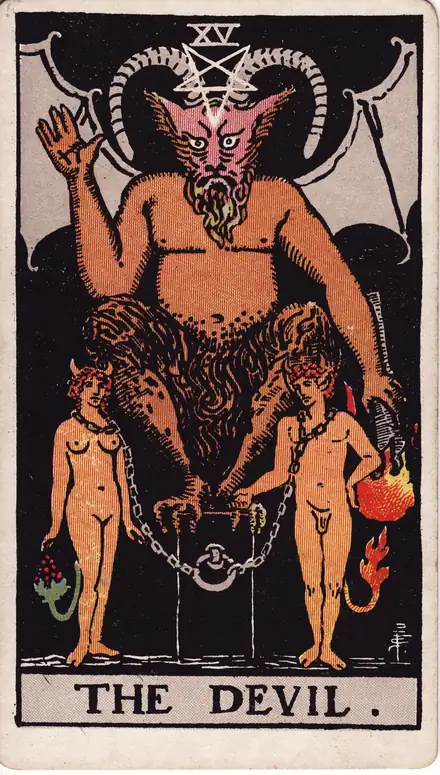
Card art: Pamela Colman Smith, 1909, for A. E. Waite. Public domain.
Trump 15
In a few words
- bondage
- temptation
- attachment
- the chain you can drop
Chained, but loosely. A habit, a fear or a person holding you that you could walk away from.
Upright
- Everything
- Chained, but loosely. A habit, a fear or a person holding you that you could walk away from.
- Love
- Passion with a hook in it: possessiveness, dependence, or a bond that traps.
- Work
- Golden handcuffs. A job kept only for the money, or a toxic boss you keep obeying.
- Money
- Debt, greed, or spending to fill a hole. The chain is on your own wrist.
- Myself
- Name the thing that owns you. Naming it is half the freedom.
Ravage, violence, vehemence, extraordinary efforts, force, fatality; that which is predestined but is not for this reason evil.The Pictorial Key to the Tarot (1911), p. 284
Reversed
- Everything
- The chain comes off. Breaking a habit, leaving a hold, seeing the trap for what it was.
- Love
- Freedom from a bond that hurt. Or the courage to set a boundary at last.
- Work
- Leaving the job that kept you small. Detachment from the fear of losing it.
- Money
- Paying off what bound you. Getting out of the debt, the scheme, the greed.
- Myself
- You have seen through it. Walk out; the door was never locked.
Evil fatality, weakness, pettiness, blindness.The Pictorial Key to the Tarot (1911), p. 284
The card, as Waite described it
The design is an accommodation, mean or harmony, between several motives mentioned in the first part. The Horned Goat of Mendes, with wings like those of a bat, is standing on an altar. At the pit of the stomach there is the sign of Mercury. The right hand is upraised and extended, being the reverse of that benediction which is given by the Hierophant in the fifth card. In the left hand there is a great flaming torch, inverted towards the earth. A reversed pentagram is on the forehead. There is a ring in front of the altar, from which two chains are carried to the necks of two figures, male and female. These are analogous with those of the fifth card, as if Adam and Eve after the Fall. Hereof is the chain and fatality of the material life. The figures are tailed, to signify the animal nature, but there is human intelligence in the faces, and he who is exalted above them is not to be their master for ever. Even now, he is also a bondsman, sustained by the evil that is in him and blind to the liberty of service. With more than his usual derision for the arts which he pretended to respect and interpret as a master therein, Éliphas Lévi affirms that the Baphometic figure is occult science and magic. Another commentator says that in the Divine world it signifies predestination, but there is no correspondence in that world with the things which below are of the brute. What it does signify is the Dweller on the Threshold without the Mystical Garden when those are driven forth therefrom who have eaten the forbidden fruit.The Pictorial Key to the Tarot (1911), p. 128
The plain-word meanings on this page were written for ShreeJyoti and are still under review.