The Hanged Man
pause · surrender · a new view · waiting
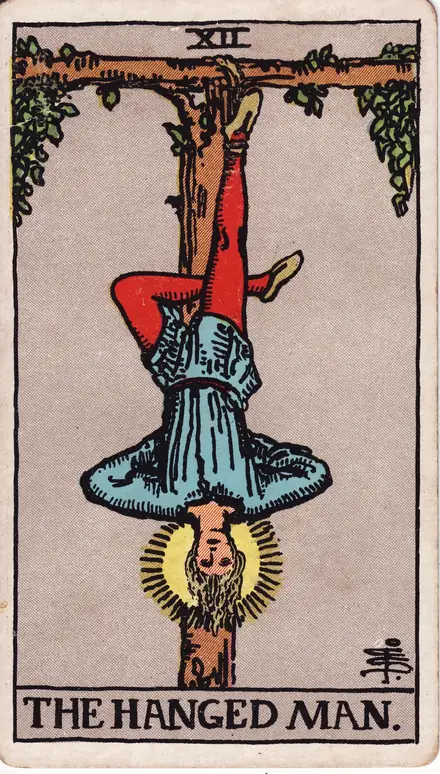
Card art: Pamela Colman Smith, 1909, for A. E. Waite. Public domain.
Trump 12
In a few words
- pause
- surrender
- a new view
- waiting
Hanging still, and seeing the world the other way up. A pause that changes how you see.
Upright
- Everything
- Hanging still, and seeing the world the other way up. A pause that changes how you see.
- Love
- Waiting, letting go of control. Sometimes love needs you to stop pulling.
- Work
- Things on hold. Use the pause to look at the problem from the other side.
- Money
- Do not act now. A sacrifice or a delay that turns out to be the right call.
- Myself
- Surrender is not defeat. Let go of the outcome and the knot loosens.
Wisdom, circumspection, discernment, trials, sacrifice, intuition, divination, prophecy.The Pictorial Key to the Tarot (1911), p. 284
Reversed
- Everything
- Stalling for no gain, or a sacrifice nobody asked for. Come down from the tree.
- Love
- Stuck in a pattern that does not move. Waiting has become avoiding.
- Work
- Delay with no new insight. Decide, even imperfectly.
- Money
- Giving up something for nothing. Check what the sacrifice actually buys.
- Myself
- Martyrdom as a habit. You have looked long enough; now walk.
Selfishness, the crowd, body politic.The Pictorial Key to the Tarot (1911), p. 284
The card, as Waite described it
The gallows from which he is suspended forms a Tau cross, while the figure—from the position of the legs—forms a fylfot cross. There is a nimbus about the head of the seeming martyr. It should be noted (1) that the tree of sacrifice is living wood, with leaves thereon; (2) that the face expresses deep entrancement, not suffering; (3) that the figure, as a whole, suggests life in suspension, but life and not death. It is a card of profound significance, but all the significance is veiled. One of his editors suggests that Éliphas Lévi did not know the meaning, which is unquestionable—nor did the editor himself. It has been called falsely a card of martyrdom, a card of prudence, a card of the Great Work, a card of duty; but we may exhaust all published interpretations and find only vanity. I will say very simply on my own part that it expresses the relation, in one of its aspects, between the Divine and the Universe. He who can understand that the story of his higher nature is imbedded in this symbolism will receive intimations concerning a great awakening that is possible, and will know that after the sacred Mystery of Death there is a glorious Mystery of Resurrection.The Pictorial Key to the Tarot (1911), p. 113
The plain-word meanings on this page were written for ShreeJyoti and are still under review.