The Hermit
solitude · searching · wisdom · a lamp
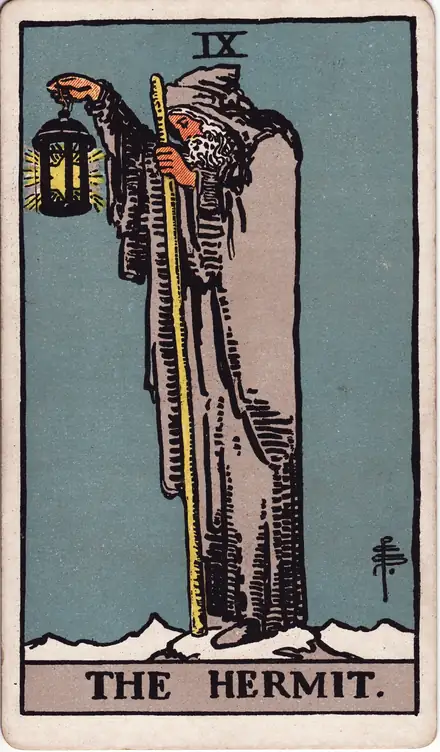
Card art: Pamela Colman Smith, 1909, for A. E. Waite. Public domain.
Trump 9
In a few words
- solitude
- searching
- wisdom
- a lamp
Time alone with a lamp. Step back, think, and let the answer come slowly.
Upright
- Everything
- Time alone with a lamp. Step back, think, and let the answer come slowly.
- Love
- A pause from company to understand what you want. Not the season for new pursuit.
- Work
- Work quietly and deeply. A specialist's path, or advice from someone older.
- Money
- Careful, private review of your finances. No show, no rush.
- Myself
- The search inward is the real work now. Silence is your teacher.
Prudence, circumspection; also and especially treason, dissimulation, roguery, corruption.The Pictorial Key to the Tarot (1911), p. 284
Reversed
- Everything
- Isolation that has gone too far, or refusing the advice you asked for. Come back a little.
- Love
- Loneliness mistaken for independence. Let someone in.
- Work
- Cut off from the team, or hoarding what you know. Share and return.
- Money
- Secretive about money, or stuck in over-caution. Take one step.
- Myself
- Hiding, not reflecting. The lamp is for walking, not for sitting.
Concealment, disguise, policy, fear, unreasoned caution.The Pictorial Key to the Tarot (1911), p. 284
The card, as Waite described it
The variation from the conventional models in this card is only that the lamp is not enveloped partially in the mantle of its bearer, who blends the idea of the Ancient of Days with the Light of the World. It is a star which shines in the lantern. I have said that this is a card of attainment, and to extend this conception the figure is seen holding up his beacon on an eminence. Therefore the Hermit is not, as Court de Gebelin explained, a wise man in search of truth and justice; nor is he, as a later explanation proposes, an especial example of experience. His beacon intimates that "where I am, you also may be." It is further a card which is understood quite incorrectly when it is connected with the idea of occult isolation, as the protection of personal magnetism against admixture. This is one of the frivolous renderings which we owe to Éliphas Lévi. It has been adopted by the French Order of Martinism and some of us have heard a great deal of the Silent and Unknown Philosophy enveloped by his mantle from the knowledge of the profane. In true Martinism, the significance of the term Philosophe inconnu was of another order. It did not refer to the intended concealment of the Instituted Mysteries, much less of their substitutes, but—like the card itself—to the truth that the Divine Mysteries secure their own protection from those who are unprepared.The Pictorial Key to the Tarot (1911), p. 104
The plain-word meanings on this page were written for ShreeJyoti and are still under review.