The Chariot
drive · victory · control · momentum
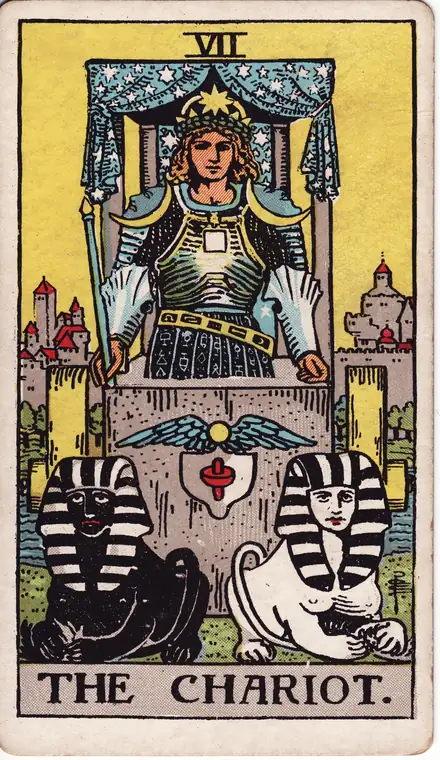
Card art: Pamela Colman Smith, 1909, for A. E. Waite. Public domain.
Trump 7
In a few words
- drive
- victory
- control
- momentum
Victory by holding the reins. Two pulls, one direction; your will decides.
Upright
- Everything
- Victory by holding the reins. Two pulls, one direction; your will decides.
- Love
- Pursue with confidence and keep your balance. Do not let the chase run you.
- Work
- Push, and push in one line. Travel or a move for work may come with it.
- Money
- Progress through determination. A vehicle, or a journey that costs and pays.
- Myself
- Discipline over the parts of you that pull different ways. You are the driver.
Succour, providence; also war, triumph, presumption, vengeance, trouble.The Pictorial Key to the Tarot (1911), p. 284
Reversed
- Everything
- Losing the reins. Aggression, a quarrel, or a plan that ran off the road.
- Love
- Ego in the way, or pushing where you should wait. Ease off the pressure.
- Work
- Momentum lost, or a fight at work you cannot win by force. Redirect.
- Money
- A vehicle or travel expense that hurts, or a rash move. Check the route.
- Myself
- Scattered energy. Pull the two horses back to one road.
Riot, quarrel, dispute, litigation, defeat.The Pictorial Key to the Tarot (1911), p. 284
The card, as Waite described it
An erect and princely figure carrying a drawn sword and corresponding, broadly speaking, to the traditional description which I have given in the first part. On the shoulders of the victorious hero are supposed to be the Urim and Thummim. He has led captivity captive; he is conquest on all planes—in the mind, in science, in progress, in certain trials of initiation. He has thus replied to the sphinx, and it is on this account that I have accepted the variation of Éliphas Lévi; two sphinxes thus draw his chariot. He is above all things triumph in the mind. It is to be understood for this reason (a) that the question of the sphinx is concerned with a Mystery of Nature and not of the world of Grace, to which the charioteer could offer no answer; (b) that the planes of his conquest are manifest or external and not within himself; (c) that the liberation which he effects may leave himself in the bondage of the logical understanding; (d) that the tests of initiation through which he has passed in triumph are to be understood physically or rationally; and (e) that if he came to the pillars of that Temple between which the High Priestess is seated, he could not open the scroll called Tora, nor if she questioned him could he answer. He is not hereditary royalty and he is not priesthood.The Pictorial Key to the Tarot (1911), p. 96
The plain-word meanings on this page were written for ShreeJyoti and are still under review.