The Lovers
love · a choice · union · values
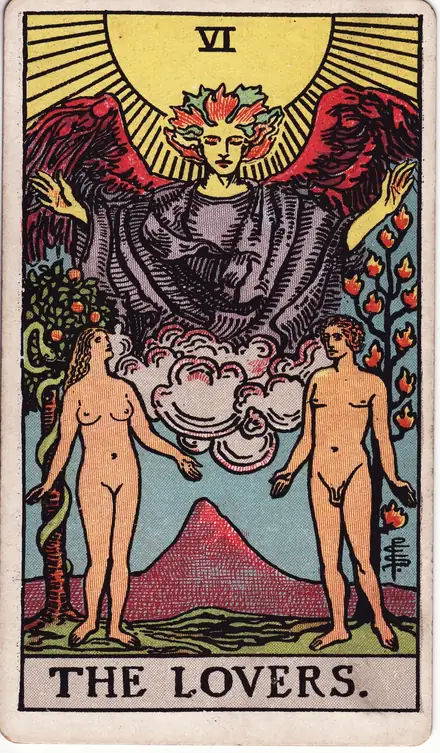
Card art: Pamela Colman Smith, 1909, for A. E. Waite. Public domain.
Trump 6
In a few words
- love
- a choice
- union
- values
Attraction, harmony, and a real choice in front of you. Choose with your whole heart.
Upright
- Everything
- Attraction, harmony, and a real choice in front of you. Choose with your whole heart.
- Love
- Love that pulls two people together. A bond that fits, or a proposal near.
- Work
- A partnership that works. Choose the offer that matches your values, not only your wallet.
- Money
- A shared financial decision. Align with your partner before you sign.
- Myself
- Know what you value; your choices are showing you who you are.
Attraction, love, beauty, trials overcome.The Pictorial Key to the Tarot (1911), p. 284
Reversed
- Everything
- Disharmony, a wrong choice, or refusing to choose at all. Something is out of tune.
- Love
- Quarrels, distance, or a match that does not fit. Do not force what keeps failing.
- Work
- A partnership pulling in two directions. Settle the disagreement before the deadline.
- Money
- Money fights, or a purchase made for the wrong reason.
- Myself
- You are torn between two selves. Pick the one you can live with.
Failure, foolish designs. Another account speaks of marriage frustrated and contrarieties of all kinds.The Pictorial Key to the Tarot (1911), p. 284
The card, as Waite described it
The sun shines in the zenith, and beneath is a great winged figure with arms extended, pouring down influences. In the foreground are two human figures, male and female, unveiled before each other, as if Adam and Eve when they first occupied the paradise of the earthly body. Behind the man is the Tree of Life, bearing twelve fruits, and the Tree of the Knowledge of Good and Evil is behind the woman; the serpent is twining round it. The figures suggest youth, virginity, innocence and love before it is contaminated by gross material desire. This is in all simplicity the card of human love, here exhibited as part of the way, the truth and the life. It replaces, by recourse to first principles, the old card of marriage, which I have described previously, and the later follies which depicted man between vice and virtue. In a very high sense, the card is a mystery of the Covenant and Sabbath. The suggestion in respect of the woman is that she signifies that attraction towards the sensitive life which carries within it the idea of the Fall of Man, but she is rather the working of a Secret Law of Providence than a willing and conscious temptress. It is through her imputed lapse that man shall arise ultimately, and only by her can he complete himself. The card is therefore in its way another intimation concerning the great mystery of womanhood. The old meanings fall to pieces of necessity with the old pictures, but even as interpretations of the latter, some of them were of the order of commonplace and others were false in symbolism.The Pictorial Key to the Tarot (1911), p. 89
The plain-word meanings on this page were written for ShreeJyoti and are still under review.